Smoky
Mountain Beef Skillet
Smoky Mountain Beef Skillet gets its name from one of its signature ingredients—smoked paprika—and because I first made it for a hiking trip in Great Smoky Mountains National Park. It's a hearty, beef-centered backpacking meal loaded with colorful vegetables. Enjoy it by itself like a thick beef chili, or serve it with bulgur, macaroni, or diced potatoes.

The beef and vegetables are cooked together in one pan, then dehydrated as a complete meal, much like chili. The bulgur, macaroni, or potatoes are cooked and dried separately, then combined with the beef mixture to create a variety of hearty meals.
Make one batch at home and you'll have enough dried beef mixture to enjoy several different trail meals simply by changing the starch.
Ingredients
Servings: Makes 5–6 cups before dehydrating; 3 cups after dehydrating.
Meat & Vegetable Ingredients:
- 1 lb. lean ground beef (454 g)
- 6 green onions (60 g)
- 1 red bell pepper (170 g)
- 6 oz. baby bella mushrooms (170 g)
- 3 medium carrots (170 g)
- 2 celery stalks (60 g)
- ¼ cup fresh parsley leaves (6 g)
- ¼ cup tomato paste (60 g)
- 1 Tbsp. Worcestershire Sauce (15 g)
Dry Seasonings & Breadcrumbs:
- ½ cup fine breadcrumbs (50 g)
- 1½ tsp. smoked paprika
- 1½ tsp. garlic powder
- 1 tsp. oregano
- 1 tsp. salt
- ½ tsp. pepper
- ¼ tsp. cayenne pepper
Substitutions:
- 1 Tbsp. dried parsley for fresh parsley
- 1 small, sweet onion for green onions
- ½ cup ground, rolled oats for fine breadcrumbs
Starches:
Smoky Mountain Beef Skillet pairs beautifully with bulgur, diced potatoes, or pasta. Each option delivers a unique taste and texture to the seasoned beef and vegetables. The starches are precooked and dehydrated before combining with the meal, so they rehydrate quickly on the trail. On a strenuous, multi-week backpacking trip, you’ll appreciate the variety and energy-boosting calories. While we enjoy all three, our favorite is Smoky Mountain Beef Skillet with Diced Potatoes.

How to Make
Smoky Mountain Beef Skillet
Prepare the Dry Seasonings &
Breadcrumbs:
Adding breadcrumbs to the ground beef before cooking helps it rehydrate exceptionally well on the trail. You’ll love the “meatloaf-soft” texture compared to the “gravelly” texture of ground beef dehydrated without breadcrumbs.
- Place fine breadcrumbs in a small bowl.
- Combine all other dry seasonings in a separate small bowl.
- Add half of the seasonings (approx. 1 Tbsp.) from the second bowl to the breadcrumbs in the other bowl.
The seasoned breadcrumbs will be added to the ground beef, and the remaining seasonings will be added to the vegetables.
Season the Ground Beef:
Use only lean ground beef with a fat content of no more than ten percent. Using lean meat helps minimize fat, which improves storage life for dehydrated meals. Learn more about dehydrating meat.

- Pull ground beef apart into small pieces.
- Sprinkle seasoned breadcrumbs over the meat and work it in with your fingers.
- Form seasoned ground beef into a big meatball and set aside while you prepare the vegetables.
Cut the Vegetables:
Beef may be the star of this meal, but the vegetables make it even better. To ensure even drying, cut the vegetables as uniformly as possible, and smaller than you would if you weren’t dehydrating the meal. Wash all vegetables before processing.

Carrots:
Peel carrots and cut them into three sections. Cut the fatter sections longwise into quarters, then slice thinly crosswise, ⅛ to ¼-inch thick. Simply cut the thinner tapered ends of the carrots crosswise.
Bell pepper:
Dice the peppers into small pieces as uniformly as possible.
Mushrooms:
Remove the tough stems. Cut larger mushrooms into halves or quarters, then slice crosswise about ¼-inch thick.
Green onions:
Also called scallions, not to be confused with spring onions. Cut off the small roots at the bulb end. Make 2–3 cuts down the length of the green onions, then slice thinly crosswise.
Celery:
Cut celery stalks longwise two or three times, then slice thinly crosswise ⅛ to ¼-inch thick.
Parsley:
Snip parsley leaves from stems with scissors and cut into smaller pieces.
Cook the
Smoky Mountain Beef Skillet
Only one pan is used to cook Smoky Mountain Beef Skillet.
- Cook carrots first and set them aside in a bowl.
- Cook ground beef next and set it aside in a bowl.
- Cook all other vegetables together.
- Add carrots and beef to vegetables to finish cooking.
Cook the Carrots:

Place carrots in pan and barely cover them with water. Cook on medium-high heat for about six minutes. Most of the water should evaporate. Transfer cooked carrots and any remaining water to a bowl.
Cook the Ground Beef:

Let the pan cool before cooking the ground beef. Pull the seasoned ground beef apart into small pieces. Add meat to pan and begin cooking at low temperature. This releases a little fat from the meat which coats the pan and prevents scorching.
Gradually increase heat to medium-high, stirring meat continuously. Cook meat until it’s brown on the outside with no pink on the inside, about 10 minutes. Set cooked meat aside in a bowl.
Cook the Remaining Vegetables:

Add the green onions, bell peppers, mushrooms, celery, and parsley to the pan along with the remaining dry seasonings. Cook on medium heat while stirring continuously, about five minutes. Add a splash of water if needed to prevent scorching.
Combine Everything & Simmer:

Add the carrots and beef back into the pan with the other vegetables. Stir in the Worcestershire sauce, tomato paste, and one cup of water. Cook on medium-high heat until bubbling, then reduce heat to low and simmer for ten minutes.
Serve Smoky Mountain Beef Skillet at home over cooked bulgur, pasta, or potatoes—or enjoy it like chili with crusty bread. It is also the perfect hearty meal to pack for the trail.
Here is how to dehydrate and rehydrate it for your next hike.
Dehydrating
Smoky Mountain Beef Skillet
This recipe produces 5–6 cups before dehydration.

Spread beef mixture in a single layer on dehydrator trays covered with nonstick sheets. If using an Excalibur dehydrator, two cups per tray works well using three trays. For smaller Cosori dehydrators, spread about 1½ cups per tray on four trays.
If possible, stir the contents of the trays around midway through the drying process to speed up dehydration.
Dehydrate at 145°F (63°C) for approximately nine hours until no moisture remains inside any of the individual ingredients. Check by tearing or cutting a few of the larger pieces in half. The ground beef will be hard, and the carrots and bell peppers will be slightly pliable.
Store in an airtight container until ready to pack for the trail.
Rehydrating
Smoky Mountain Beef Skillet on the Trail
Enjoy this hearty meal four ways on your next backpacking trip—by itself, or combined with bulgur, macaroni, or diced potatoes.

Whichever variation you choose, pack all the dried ingredients together in one freezer bag.
Cooking method for each variation is the same:
- Place dried meal in a pot with required water.
- Soak five minutes, then light stove.
- Bring to boil and continue cooking for one minute, then set pot aside for twenty minutes with the lid on.
- A little savory gravy will surround the pleasantly chewy beef and vegetables. Use a spoon—you won’t want to miss a drop.
Smoky Mountain Beef by Itself
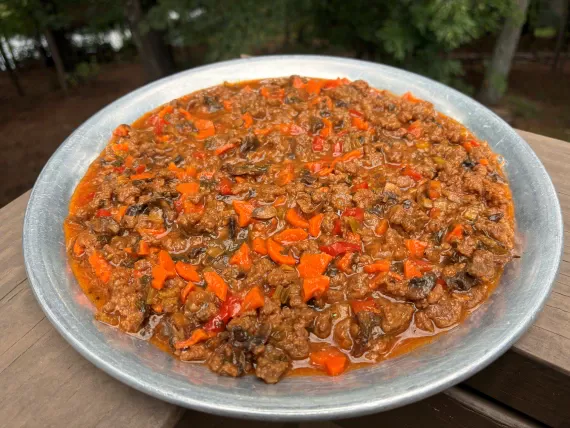
One Serving:
- 1 cup dried smoky mountain beef (90 g)
- 1¼ cups water to rehydrate
Smoky Mountain Beef with Bulgur

One Serving:
- ½ cup dried smoky mountain beef (45 g)
- ½ cup dried bulgur (45 g)
- 1¼ cups water to rehydrate (296 ml)
Smoky Mountain Beef with Macaroni
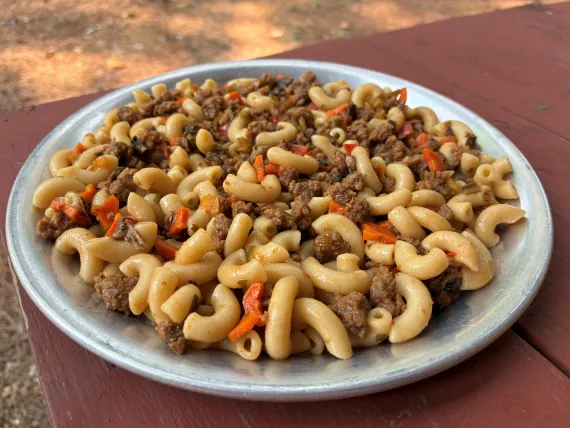
One Serving:
- ½ cup dried smoky mountain beef (45 g)
- ½ cup dried macaroni (45 g)
- 1¼ cups water to rehydrate (296 ml)
Smoky Mountain Beef with Diced
Potatoes
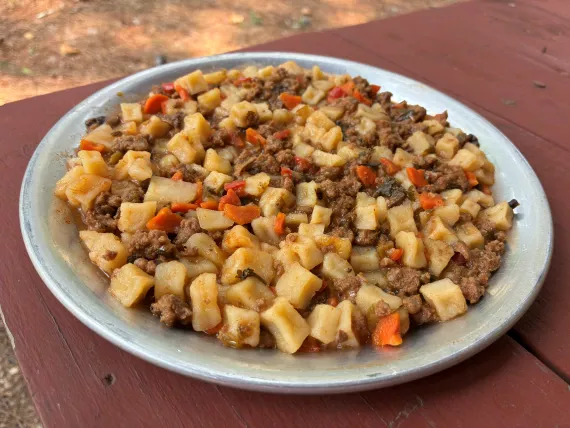
One Serving:
- ½ cup dried smoky mountain beef (45 g)
- ½ cup dried diced potatoes (45 g)
- 1¼ cups water to rehydrate (296 ml)
Thermos Hiking Lunch

We loved this meal as a thermos lunch on the Gahuti Trail at Fort Mountain State Park in Georgia. To make a thermos meal, add the ingredients and boiled water to a thermos food jar before leaving home or your campsite. Find a spot with a view when you get hungry, and dig in. We share an extra-large serving.
One X-Large Serving fills a 24 oz. thermos food jar to capacity.
- ¾ cup dried smoky mountain beef (65 g)
- ¾ cup dried diced potatoes (65 g)
- 2 cups water boiled to rehydrate (473 ml)
Conclusion
Whether you serve Smoky Mountain Beef Skillet with bulgur, macaroni, or diced potatoes, you'll end up with a satisfying meal that's packed with flavor and nourishing ingredients. It's one of those dependable backpacking recipes that's easy to make at home, dries beautifully, and gives you several delicious options on the trail. We loved it in the Smokies, and I hope you’ll enjoy it just as much on your next adventure.


Share this page with friends on social media.

Free E-book & Newsletter
Free with Trail Bytes subscription.

Dehydrating Food from A–Z